Transparency
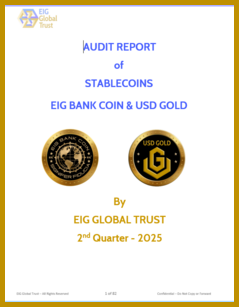
We have completed an independent security audit of both of our Tier-1 asset backed stablecoins EIG Bank Coin (EIGBC) and USD Gold (USDAU). Additionally, a licensed CPA conducted an audit applying the American Institute of Certified Public Accountants (AICPA) criteria on stablecoin reporting. The audit specially focused on the proof of reserves for both our asset-backed stablecoins.
BANK ASSET SCREEN (AUDIT SCREEN) DISCLOSURE: EIG Global Trust was provided an official printout of a banking terminal screen showing the Tier-1 asset gold backing of our stablecoins. This terminal screenprint has been referred to as various color screens and “audit screen”. EIG Global trust has only shown redacted versions (due to code and account name sensitivities ) of the Bank Asset Screen on this website, in marketing materials, and associated audit reports. The Bank Asset Screen shows EIG Global Trust as the assigned entity of allocated assets used for the Tier-1 asset (assigned gold) backing of our stablecoins. No mention of the specific location or which bank may hold these assigned assets has ever been made by EIG Global Trust. No mention of any bank entity “auditing” EIG Global Trust, the company, has been made. The Bank Asset Screen is terminal accessible through official channels in the banking community. For more information, please contact us info@eigglobaltrust.com.
Independent Security and Smart Contract Blockchain Audits
EIG Global Trust hired the world’s leading blockchain security & smart contract auditing firm, Hashlock Pty Ltd to conduct a full independent review of our EIBGC and USDAU blockchains and stablecoins. In summary, Hashlock audit reports state both blockchains used and their security are secure and no significant issues were found.
The Hashlock audits can be requested by partners, subject to EIGGT approval.
Regulatory Compliance
Although EIG Global Trust stablecoins do not fall into either category, we worked continuously with the world’s regulatory bodies to ensure their blockchains, stablecoins, internal processes, and accounting comply.
The United States recently passed The GENIUS Act of 2025 (Guiding and Establishing National Innovation in U.S. Stablecoins). It’s 3 main provisions: 1) Large issuers with over $10 billion in market capitalization would be regulated by the Federal Reserve and the Office of the Comptroller of the Currency, the smaller issuers would be regulated on a State level. 2) All issuers must back their stablecoins based on 1-to-1 (100%) reserves with U.S. currency, demand deposits, or short-term (90 day or less) Treasury bills, ensuring that each digital dollar is redeemable on demand. 3) Prohibit algorithmic stablecoins.
On 5 March 2025, the AICPA issued 2025 Criteria for Stablecoin Reporting: Specific to Asset-Backed Fiat-Pegged Tokens. This audit applies the AICPA criteria to EIG Global Trust stablecoins. The AICPA recommends using a specific measurement point in time for reporting purposes of stablecoins, this audit report measurement point is 9 May 2025.
The European Union’s (EU) Markets in Crypto-Assets Regulation (MiCA), issued in December 2024 require stablecoin proof of reserve funds that are pegged to a single fiat currency (like EIG Global Trust stablecoins) to segregate at least 30% at credit institutions or invested in certain “secure, liquid low-risk assets”. Meanwhile, the balance is to be invested in assets which qualify as a defined class of “highly liquid financial instruments with minimal market risk, credit risk and concentration risk”.
Proof of Reserves Audit
This internal audit conducted in 2Q 2025 applies the AICPA criteria to EIG Global Trust stablecoins. The AICPA recommends using a specific measurement point in time for reporting purposes of stablecoins.
The primary objective of stablecoin audits is to determine “Proof of Reserves” are complete, accurate, and disclosure in the token issuer’s (EIG Global Trust) redeemable tokens outstanding, redemption assets available to redeem, and the redemption assets are equal to or greater than the redeemable tokens outstanding. In summary, the stablecoin audit:
Review of EIG Global Trust Stablecoins
Verification of the stablecoin project owners
How the Stablecoins are Transacted and Exchanged
Review of the Token Issuer Terms
Proper Classification and Accounting of the Redeemable Tokens
Accuracy of Proof of Reserves Calculation